
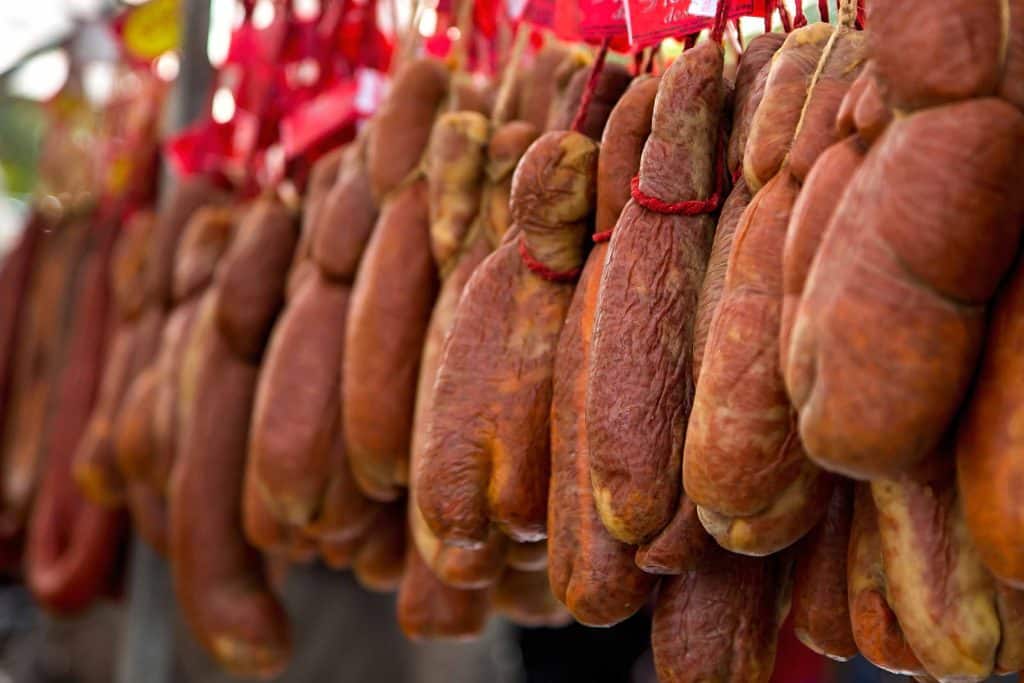
There are products you simply taste and enjoy. And then there are those that also tell the story of a place. Sobrasada from Mallorca belongs firmly in the latter category. A slice of warm toast, the unmistakable aroma of paprika and that characteristically smooth, spreadable texture are enough to understand that this is more than just a cured sausage: it is a living part of the island’s gastronomic heritage.
In Mallorca, the pig has historically played a central role in both the island’s cuisine and domestic life. The traditional matances, held for centuries, were not simply a way of stocking the pantry: they were also an expression of culture, community and knowledge passed down from generation to generation. Within this tradition of botifarrons, camaiots, llonganisses and other local specialities, sobrasada gradually became one of the great emblems of Mallorcan gastronomy.
What is Sobrasada from Mallorca?
Sobrasada is a raw cured sausage made from minced pork, salt, pepper and paprika, with the paprika giving it its distinctive reddish colour as well as much of its aroma and character. It may also contain permitted spices in varying proportions, depending on each producer’s recipe, but one thing remains unchanged: the balance between flavour, texture and curing.
What sets it apart at first glance is its soft, smooth, cohesive texture and marbled red appearance. It does not have the dry firmness of other cured sausages, nor does it try to resemble them. That is precisely where part of its uniqueness lies. Sobrasada can be spread, melted or gently warmed; it infuses bread with its aroma and can transform a dish with just a small amount.
Talking about what sobrasada is involves more than simply defining its ingredients. It means understanding that this is a product deeply connected to the climate, traditional methods of food preservation and local know-how. That is why, when it comes to authentic Mallorcan sobrasada, origin matters.
The origins of sobrasada and its connection to Mallorca
The origins of sobrasada lie somewhere between documented history and Mediterranean culinary tradition. It is considered a product with distinctly Mediterranean roots. According to various historical references, its preparation may have reached Mallorca through preservation techniques developed during the Renaissance in territories such as Sicily. There, sopressa was made, a type of cured sausage preparation whose name is etymologically linked to the term sobrasada.
What matters, beyond the exact chronology, is that Mallorca made it its own. The island’s climatic conditions were less suited to preserving whole cured cuts than to producing sausages. This helped sobrasada become established early on in Mallorcan pantries as an effective way of preserving pork. Over the centuries, it ceased to be merely a practical food and became one of the most recognisable symbols of traditional Mallorcan cuisine.
The introduction of paprika in the modern era ultimately gave sobrasada the colour and aromatic profile we now immediately associate with it. Since then, the essence of sobrasada has changed very little. And perhaps that is a good thing: some flavours do not need reinventing to remain relevant.
Why sobrasada is a symbol of Mallorcan gastronomy
Few products explain the relationship between place, tradition and cuisine as clearly as sobrasada. It is deeply rooted in the island’s culinary identity, found in many household pantries, at important celebrations and in everyday recipes. It is not simply a speciality known beyond Mallorca: it is a central part of the island’s gastronomic identity.
Moreover, its prestige does not rest solely on oral tradition or emotional attachment. The IGP Sobrassada de Mallorca protects and certifies the quality and origin of products that meet strict requirements for production, preparation, curing and labelling. This Protected Geographical Indication recognises precisely what makes the product so distinctive: its close connection to Mallorca, its environmental conditions and the human expertise that has kept the traditional process alive.
There are also two main types recognised by the PGI: Sobrassada de Mallorca, made with selected pork, and Sobrassada de Mallorca de Porc Negre, made with meat from the native Mallorcan breed. In the latter case, its connection to the island’s identity is even stronger, as the porc negre forms part of Mallorca’s livestock heritage and its rearing is closely regulated.
Types of sobrasada and the best-known varieties
Within Sobrasada de Mallorca, there are several traditional formats, and knowing them helps show that there is no single way to enjoy it. Longaniza is usually the quickest and lightest to consume, with an approximate weight of between 200 and 300 grams. Rizada is probably the most common, with a curing period of several weeks and an average weight of around 800 grams. There are also semirrizada, culana, bufeta, poltrú and even larger pieces sold in tubs, which are far less common in everyday consumption.
Each format influences the curing process, intensity and the way it is enjoyed. Smaller pieces tend to offer fresher flavour profiles, while larger ones develop deeper, more complex nuances. It is not simply an aesthetic or commercial distinction, but a different way of experiencing the product.
How is sobrasada traditionally eaten?
The most classic way is also one of the most effective: sobrasada spread on bread, served at room temperature or slightly warmed so that its full aroma can develop. But limiting it to that would be doing it a disservice. In Mallorcan cuisine, it has been used for generations as a natural flavour enhancer, especially in more broth-based dishes or recipes where a small amount could transform the whole preparation.
It has also long been paired with contrasts that can still surprise those unfamiliar with them. The combination of honey and sobrasada, for example, is one of those pairings that may seem unlikely until you try it. It works cold on toast, but also warm, when the sobrasada melts and the honey adds a sweet contrast that rounds off the bite.
And it does not end there. Sobrasada can be used in fillings, rice dishes, sofritos, doughs, empanadas, cocas and even sweet recipes. This versatility explains why it forms part of traditional Mallorcan food not only as a product to enjoy on its own, but also as an ingredient with a distinctive character of its own.
Sobrasada in contemporary cuisine
What makes great traditional products so interesting is that they are not confined to nostalgia. They remain relevant because they lend themselves to new interpretations. Used well, sobrasada can bring depth, richness, aroma and a subtle spiced note to contemporary recipes without losing its identity.
It can appear in a fish dish, a sauce, a croquette, pasta or a rice dish and still remain unmistakable. In fact, that is precisely where its strength lies: it does not need to overpower. Just a small amount is enough to leave its mark.
From this contemporary perspective, the key is not to disguise tradition, but to treat it with respect. Sobrasada does not need embellishment; it needs judgement. Knowing when to let it shine and when to let it play a supporting role.
Local produce, a sense of place and purposeful cooking
Understanding sobrasada means understanding an essential part of Mallorca. Not only because of its flavour, but because it brings together many of the ideas that are once again becoming central to gastronomy today: local sourcing, traceability, knowledge of the product and respect for the natural rhythms of each place.
At a time when so many kitchens are seeking to reconnect with the origins of what they serve, sobrasada continues to remind us of something simple: that the value of a product does not depend solely on its fame, but on the cultural ecosystem that sustains it. Mallorcan cuisine has one of its greatest strengths precisely there.
S’Era de Pula and a contemporary take on the flavours of the land
In a restaurant like S’Era de Pula, this way of understanding food comes naturally. Our approach, deeply rooted in Mediterranean cuisine, local produce and seasonality, reflects a vision of Mallorca that goes beyond the postcard image and finds its expression at the table. Here, respect for ingredients, sensitivity to local sourcing and a commitment to cooking with purpose all form part of the restaurant’s identity.
That is why sobrasada does not appear as a simple folkloric nod, but as one of those flavours that works naturally within a cuisine that looks to the land with honesty and a contemporary sensibility. Discovering Mallorca through its most emblematic products also means sitting down at a table where that heritage is interpreted with care and without pretence. Ultimately, sobrasada is much more than a gastronomic symbol. It is memory, pantry, technique, landscape and flavour. And perhaps that is why it continues to hold such a special place on the island: because every bite contains something familiar, something deeply Mallorcan. Taking the time to discover it is a delicious way to get closer to Mallorca. And doing so at a place like S’Era de Pula, where local produce is treated with respect and personality, can be a wonderful way to continue understanding the island through what matters most: its cuisine.