
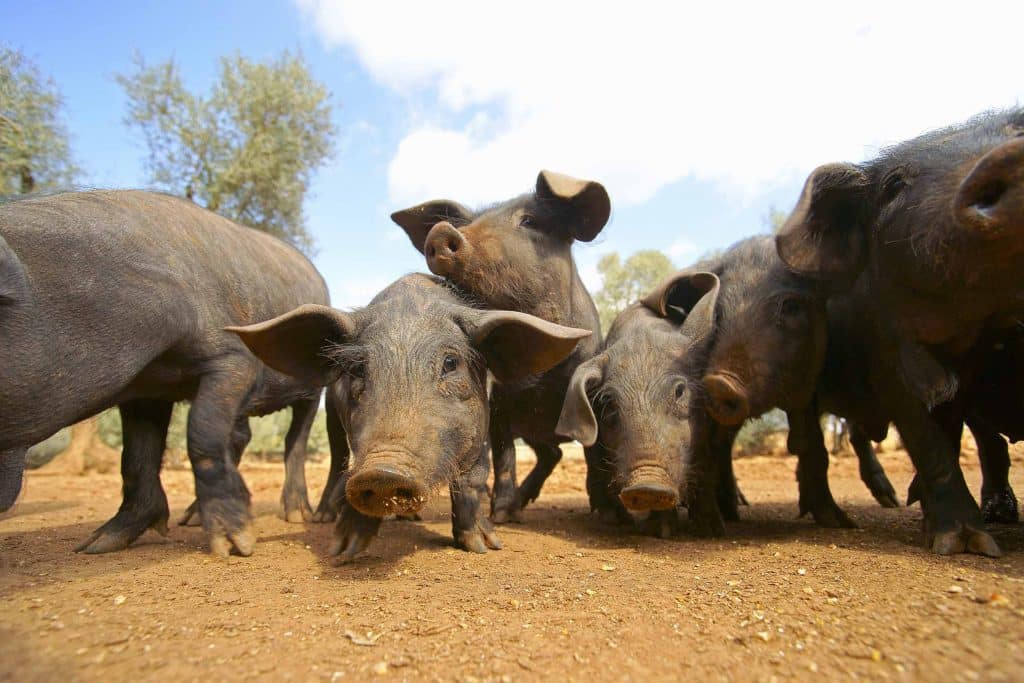
There are products you understand through taste, yes. But also through the landscape, through history and through that distinctly Mallorcan way of doing things slowly, with craftsmanship and memory. The Mallorcan black pig is one of them. It is not “just another pig”, nor a gastronomic curiosity for tourists. It is a native breed, a symbol of rural Mallorca and, above all, an ingredient that has sustained kitchens, pantries and celebrations for centuries.
If you have ever wondered why sobrasada enjoys almost sacred status in Mallorca, or why porcella is still a dish reserved for special occasions, much of the answer lies here.
What is the Mallorcan black pig?
The Mallorcan black pig (also commonly known as porc negre or porc mallorquí) is Mallorca’s native pig breed. Its name says it all: one reference is morphological, to its dark colouring, and the other geographical, to its island origin.
What makes it unmistakable
From a morphological point of view, it is described as a medium-sized animal, with a black or slate-grey coat, large ears that fall forwards, a slightly concave frontonasal profile and one particularly distinctive feature: the presence of two “mamellas” or “ganyells” at the base of the neck. It is a breed with a high proportion of fatty tissue, something that, in a world obsessed with lean meat, is understood here for what it really is: gastronomic potential.
Origins: what we know (and what we don’t)
Its exact origin is uncertain, but it is thought to descend from a pig population already present on the island since the arrival of its earliest settlers, shaped by two processes: an additive one, through contributions from the different civilisations that passed through Mallorca — with the exception of the Muslim period for cultural and religious reasons — and an adaptive one, resulting from a combination of natural selection and human selection.
The result is a breed deeply adapted to Mediterranean conditions and to extensive or semi-extensive farming systems.
A rural story written slowly over time
For a long time, the porc negre was, quite literally, Mallorca’s pig. Well into the first half of the 20th century, it was considered the dominant breed in the island’s pig farming. And that has a major consequence: traditional Mallorcan cuisine, as we know it today, was built to a large extent around this animal.
The matanza and the culture of making the most of every part
Talking about the porc negre means talking about a rural culture in which nothing was wasted. The matanza was not simply about “making cured meats”: it was a domestic ritual, a way of securing food, fat, preserves, a feast and a stocked pantry for the months ahead. Within that logic, fat was not the enemy: it meant energy, flavour and preservation.
Porcella: the dish for special occasions
The porcella (suckling pig) holds a particularly important place in Mallorcan gastronomy. It refers to a young pig, male or female, that remains with its mother while suckling and is slaughtered at a very young age, usually before three months old and at a low carcass weight. Historically, it has been a dish associated with celebrations such as Christmas, family gatherings and other special occasions. It was never an everyday product: it was a form of rural luxury.
And it is not simply a matter of oral tradition. Records and cultural references show its social importance, even as a valuable product that was especially sought after at certain times of the year.
From past to present: the Mallorcan black pig in contemporary gastronomy
What makes the porc negre particularly interesting is not simply that it has “existed for centuries”. It is that, despite the pressure of intensive farming models and foreign breeds, it has survived to the present day with a strong identity… and with the argument that matters most in gastronomy: quality.
Mallorcan cured meats: sobrasada, camaiot and botifarró
Its leading ambassador is sobrasada, particularly when made from porc negre under certified control and traceability schemes. For porc negre used to make sobrasada, particular emphasis is placed on appropriate rearing and a controlled diet (cereals, pulses and figs, among other traditional feed sources), with audits and supervision of farms when production is carried out under a certified label.
But the story does not end there: camaiot and botifarró are also part of Mallorca’s traditional cured-meat heritage, reflecting a distinctive way of curing, seasoning and preserving that is entirely rooted in the island.
Fresh meat: increasingly present
For years, the story of the porc negre was associated almost exclusively with cured meats. Today, fresh meat is gaining prominence: cuts cooked more simply, stews and roasts, traditional recipes such as frit, as well as contemporary preparations that seek precision without losing their soul. The common thread is usually the same: produce with character, well-integrated fat and a texture that, when treated with respect, is truly exceptional.
Local produce, sustainability and a sense of place
It is worth being clear here: “sustainable” is not just a decorative label. With the porc negre, the connection to the land is quite literal.
Extensive farming and the use of local resources
The traditional production system — today more commonly semi-extensive in many cases — is based on hardy animals that are well adapted to their environment and make use of pasture, scrubland and fruit from Mediterranean crops such as fig trees, carob trees and almond trees, as well as prickly pears and crop residues. Their diet is supplemented with cereals and pulses such as barley, peas or chickpeas. It is a way of farming closely linked to the agricultural cycle and the landscape.
Conservation of a native breed
The porc negre has at different times been classified as a specially protected or endangered breed, and its survival is supported, among other factors, by its gastronomic value: if there is demand for the product and it is paid for according to its true worth, the breed can be preserved. To guarantee purity and traceability, there is an official herd book managed by recognised breeders’ associations. This is not a mere bureaucratic detail: it is the foundation that prevents the concept from becoming simply “any black pig sold with a good story”.
In a world where uniformity prevails, protecting a native breed means protecting diversidad genética, cultura alimentaria y economía local.
The gastronomic value of porc negre at the table
The appeal of the porc negre is not that it is “exotic”. Its real value lies in its culinary personality.
Fat: the ingredient many people fail to appreciate
The porc negre has a naturally high fat content. When handled properly, this translates into succulence, a silky texture and lingering flavour. We are not talking about “heavy” fat, but the kind that, when well integrated, makes a mouthful truly memorable.
Versatility: from traditional cooking to refined cuisine
It works beautifully in cured meats, where fat is essential, as well as in roasts such as porcella, with its crisp skin and tender meat. It also has a place in traditional stews and in contemporary cuisine, where balance is key: precise techniques, carefully controlled cooking points and combinations built around contrast, from sweet and savoury notes to spices and local herbs.
The porc negre is tradition, yes. But it does not belong in a museum. It belongs at the table, when it is cooked with thought and respect.
Enjoying porc negre and Mallorcan gastronomy at S’Era de Pula
After all this, the idea is simple: if you really want to get to know Mallorca, do not start with the slogans. Start with the produce. And the porc negre is one of those gateways that never disappoints, bringing together history, landscape and cuisine in a single thread.
At S’Era de Pula, that philosophy is rooted in respect: for the land, for the island’s producers and for a Mallorcan cuisine that does not need to disguise itself to impress. The aim here is not to “do something modern” at any cost, but to do things properly, with coherence and with produce that makes sense. If you would like to experience Mallorca through its gastronomy, with porc negre taking centre stage and the rest of the island’s larder playing its part, the plan is simple: take a seat at the table and let the flavours tell the story. Book your table at S’Era de Pula and enjoy Mallorcan cuisine as it should be: honest, carefully prepared and deeply connected to its land.