
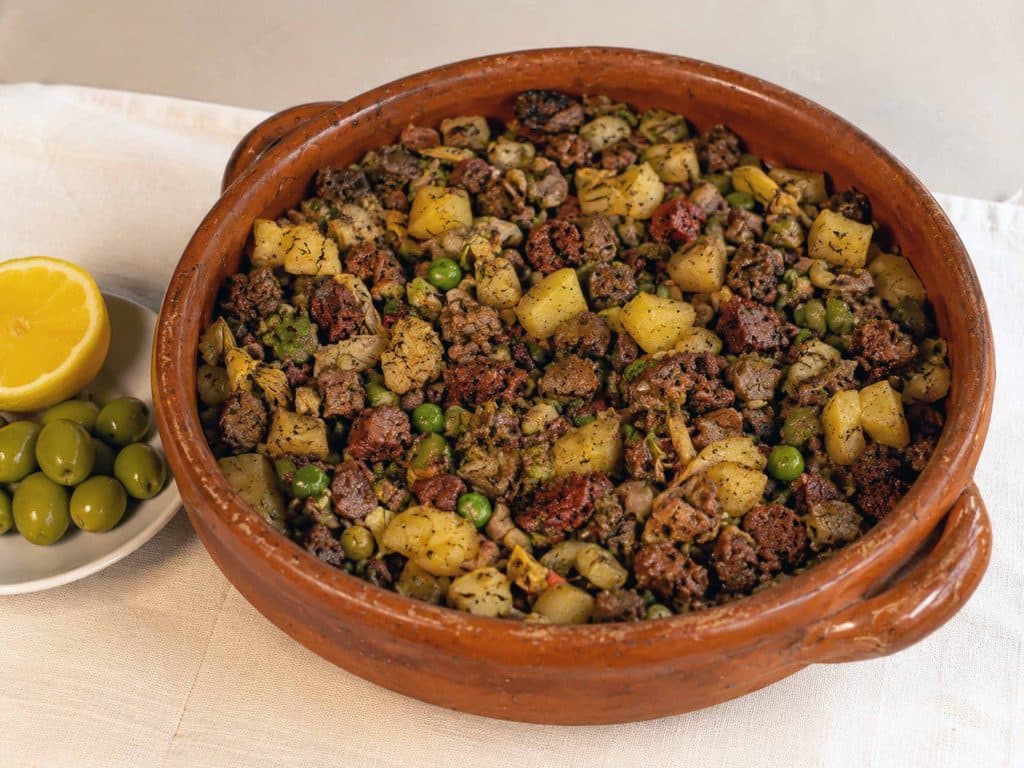
Frit mallorquí is one of those dishes that tells us far more than a recipe alone ever could.
To speak of frit mallorquí is to speak of family kitchens, local produce, markets, pig-slaughter traditions and a way of understanding food that is deeply rooted in the land and the seasons. It is not a dish designed to impress through sophistication. Its value lies precisely in the opposite: in the deep flavours of recipes passed down through generations.
Within Mallorcan cuisine, few dishes have such a distinctive identity. Although every household has its own version, frit retains something essential: that intense combination of meat, vegetables, potato, spices and fennel that makes every mouthful a hallmark of Mallorcan identity.
What is frit mallorquí?
Frit mallorquí is one of the most iconic dishes in traditional Mallorcan cuisine.
It is made with meat, offal, potatoes, vegetables and spices, cooked separately and then slowly combined to create a dish full of flavour, aromas and subtle nuances.
Although it can now be found in restaurants and traditional cellers across the island, its origins are humble and domestic. It arose from the need to make the most of the available ingredients, especially during the traditional pig-slaughter season, a custom deeply rooted in Mallorca for centuries.
In fact, many consider frit to be one of the oldest recipes in Mallorcan cuisine.
And that is probably where part of its authenticity lies: it remains a dish deeply connected to local memory and produce.
A dish rooted in Mallorca’s pig-slaughter tradition
To truly understand frit de matances, we must first understand the importance of the matances tradition in rural Mallorcan life.
For generations, pig-slaughter days were not only a way of securing food for much of the year. They were also family and social occasions. They brought several generations together around the kitchen, the courtyard and the fire.
It is precisely from this context that one of the most traditional versions of frit mallorquí emerged.
After the pig slaughter, many parts of the pig that were not used for cured meats or preserves went into preparing this rich, hearty dish. Ingredients include liver, offal and different cuts of meat combined with potatoes, peppers, onion, fennel and spices.
The result was not intended to be delicate. It was about flavour, sustenance and making use of every ingredient.
Even today, when you taste a good frit de matances, it still carries something of that old, straightforward Mallorcan cooking, deeply rooted in the land.
Frit: Home-Style, Slaughter-Day and Market Versio
Although frit mallorquí is often spoken of as a single recipe, there are several versions closely linked to the occasion, the setting and the ingredients available.
Home-style frit is probably the most personal version. Every Mallorcan family makes small changes: more fennel, more potatoes, different proportions of meat or even its own particular blend of spices. Some recipes are drier and others more succulent, with some versions milder and others far more intense
Frit de matances is probably the most traditional and hearty version. It is directly linked to the pig-slaughter tradition and is usually prepared with richer ingredients and deeper flavours.
Then there is frit de mercat, a version closely connected to fresh seasonal produce and the kitchens of Mallorca’s markets. This version can be somewhat lighter and more vegetable-led, while always retaining the essence of traditional frit.
All the versions share something important: the feeling of eating a recipe born from the ingredients rather than from sophistication.
The ingredients that define the flavour of frit mallorquí
Part of the character of frit mallorquí lies precisely in its ingredients.
The base usually combines potatoes, liver, different meats, onion, red pepper, green pepper, tomato, garlic and fennel. Then come the spices, which are essential for creating that distinctive flavour of traditional Mallorcan cuisine.
Fennel is probably one of the most recognisable ingredients. It adds a distinctly Mediterranean, slightly aniseed aroma that completely transforms the dish.
Getting the frying just right is also important. Frit mallorquí has all the character of unhurried cooking and a large shared frying pan. The ingredients are cooked slowly until they achieve the right balance of texture, intensity and aroma.
Although it may seem like a simple dish, making a good frit requires precisely what defines so many traditional recipes: experience, quality ingredients and patience.
Much more than traditional Mallorcan food
Traditional Mallorcan dishes are sometimes considered solely from a culinary perspective.
But frit mallorquí goes much further than that.
It is a dish that speaks of ways of life, seasonality, resourceful cooking and a very particular relationship with local produce. It also reflects a less tourist-oriented, more everyday Mallorca, connected to the island’s interior, its markets and family kitchens.
That is probably one of the reasons why it remains so highly valued by both locals and travellers keen to discover the island’s culinary culture from a more authentic perspective.
Mallorcan cuisine to savour at a leisurely pace
Traditional Mallorcan cuisine is often best understood when enjoyed slowly.
Without rushing.
Sharing the table.
Frit mallorquí clearly belongs to that category of dishes that call for time and conversation. It is neither a quick recipe nor something intended for immediate consumption. It carries something of old Mediterranean cooking, long lingering meals and ingredients prepared with care.
That is precisely why enjoying this type of cuisine in places connected to the land completely transforms the experience.
In places such as S’Era de Pula, where the natural surroundings, Mallorcan tradition and local produce are all part of the dining experience, dishes such as frit mallorquí feel particularly at home.
Ultimately, much of Mallorcan cuisine cannot be understood through flavour alone.
It is also understood through the landscape, the pace of life and the way people gather around the table.