
Sustainability in a restaurant can begin in many different places. In the choice of an ingredient, in the way a space is lit or in deciding what journey a product can take once it is no longer going to be used in the kitchen.
At S’Era de Pula, these decisions have formed part of a shared commitment with Pula Golf Resort for the past 25 years, through projects and initiatives linked to sustainability and social innovation.
Within the restaurant, much of this philosophy can be understood by looking at how produce, the surroundings and the use of resources are interconnected. A model in which the circular economy applied to gastronomy is not focused on a single measure, but is present at different moments throughout the day.
Long before the first dish arrives
One of the starting points lies outside the kitchen.
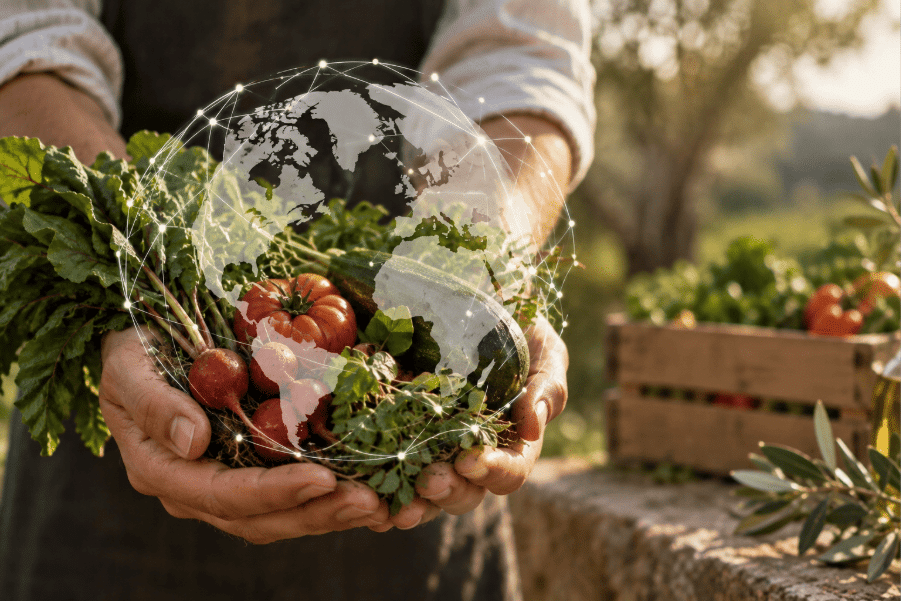
S’Era de Pula has a 6,000 m² organic kitchen garden that partially supplies the restaurant. What grows there keeps the kitchen connected to the seasons and allows produce from the surrounding area to be incorporated into different dishes.
But the journey neither begins nor ends in the kitchen garden.
While some ingredients arrive directly from this space, others come from local producers and suppliers. The wine also maintains this connection with the island, with a production process carried out in collaboration with a Mallorcan winery.
The result is a cuisine in which provenance and seasonality set the pace. Not everything is available all year round, and this evolution is precisely part of S’Era de Pula’s relationship with its produce.
The S’Era de Pula menu features a range of dishes that reflect this connection with the kitchen garden and the surrounding environment.
What happens afterwards matters too
The kitchen also generates resources that can have a second life.
Some of the organic waste is used as feed for the hens on the estate. Their eggs can then return to the kitchen and become part of some of the restaurant’s dishes.
It is a simple dynamic, but it clearly reflects the logic behind certain decisions at S’Era de Pula: making use of what can still serve a purpo
The same idea extends beyond the restaurant. Surplus food that can still be put to good use is shared through donations, connecting this way of working with the local community.
In this way, a product’s journey does not always end when it is no longer used in the kitchen. In some cases, it continues within the same space; in others, it finds a purpose beyond it.
A sustainable kitchen also depends on what we don’t see
Not every decision related to sustainability appears on the plate.
While the kitchen garden follows its own rhythm, the restaurant uses LED lighting as well as its own green and solar energy. Digitalisation has also been incorporated as a tool to reduce the environmental impact associated with the restaurant’s activity.
In a completely different area, S’Era de Pula has eliminated plastic packaging from its restaurant and uses ecopacks for certain cleaning tasks.
Even everyday items such as napkins are part of these decisions, with environmentally friendly alternatives being used.
These changes affect different aspects of day-to-day operations. That is precisely why they help show that sustainability does not depend on one major action, but on how many decisions are made throughout the entire activity.
From local produce to biodiversity
Working in connection with the local environment also means paying attention to what surrounds the restaurant.
The preservation of biodiversity forms part of S’Era de Pula’s commitment, while its relationship with local producers extends this connection with Mallorca beyond the kitchen garden.
They are two different areas of work, but both are focused on the same surroundings.
This is complemented by a social dimension based on equality and non-discrimination, which is also incorporated into the way the project is understood.
Sustainability is therefore no longer limited solely to environmental issues. It also extends to the relationship with people and with the community of which S’Era de Pula forms part.
Even getting to the restaurant can be part of the change
The measures adopted are not limited to the kitchen or the growing areas.
S’Era de Pula also offers electric vehicle charging, adding another measure linked to the everyday use of the space.
It is a good example of how the project works across very different areas: while part of the activity takes place among crops and in the kitchen, other decisions are made in areas that may seem, at first glance, to have little to do with gastronomy.
All of them form part of S’Era de Pula’s commitment to sustainability.
Restaurant, golf course and accommodation: a shared commitment
S’Era de Pula’s sustainability cannot be completely separated from the wider project of which it forms part.
While the restaurant focuses closely on the kitchen garden, the cuisine and the efficient use of resources, Pula Golf Resort approaches this commitment through the specific characteristics of the golf course and the accommodation.
There, different issues take centre stage, such as the management of water used on the golf course or solutions related to energy and technology. Work is also carried out on the carbon footprint and the evolution of sustainability goals.
Certifications, the team and the community complete this approach from the resort’s perspective.
You can discover this other side of the project in the article about how Pula Golf Resort approaches sustainability across the golf course and accommodation.
S’Era de Pula and Pula Golf Resort thus develop the same commitment through different activities, without necessarily applying exactly the same solutions.
From the kitchen garden to the table, and far beyond
A kitchen garden may be one of the most visible elements of this story, but focusing on it alone would mean telling only part of it.
S’Era de Pula’s philosophy is also reflected in the way certain waste is reused, in the choice of local suppliers and in the sharing of surplus food. It is present in decisions related to energy, cleaning and day-to-day operations.
Each action has its own place, but together they help build an approach to gastronomy that is connected to what happens before and after a dish is served.
Now that you know the connection between the produce and the table, all that remains is to book and experience it first-hand.